Ghana National Nutrition Policy
The National Nutrition Policy (July 2016), serves as a comprehensive framework and audit of Ghana’s nutrition landscape, outlining the strategies required to improve health outcomes across the life course. It emphasizes that optimum nutrition during the fetal and early childhood stages is critical for cognitive and physical development, which eventually leads to increased adult productivity and economic growth.
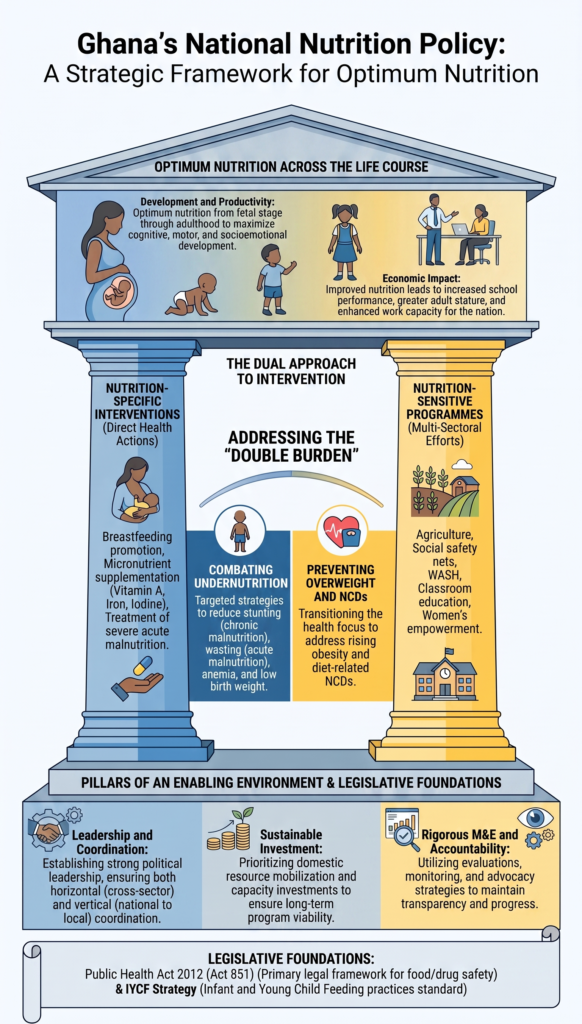
The document organizes nutrition efforts into three primary areas:
- Core Intervention Strategies
The framework distinguishes between two types of programs:
-
- Nutrition-Specific Interventions: These are health-based actions focusing on maternal and child health, including breastfeeding and complementary feeding, micronutrient supplementation (Vitamin A, Iron, Iodine), and the treatment of severe acute malnutrition.
- Nutrition-Sensitive Programs: These are cross-sectoral approaches that address the underlying causes of malnutrition. Key areas include agriculture and food security, social safety nets (such as the LEAP program), water and sanitation (WASH), and women’s empowerment.
- Policy Goals and Health Outcomes
The policy aims to address a “double burden” of malnutrition by focusing on:
-
- Reducing Undernutrition: Targeting stunting, wasting, underweight, and low birth weight.
- Preventing Overnutrition: Addressing the rising rates of obesity and non-communicable diseases (NCDs).
- Micronutrient Deficiency: Implementing strategies for universal salt iodization and iron-folate supplementation.
- Building an Enabling Environment
To ensure success, the document highlights the need for a supportive governance structure, which includes:
-
- Horizontal and vertical coordination across government sectors.
- Domestic resource mobilization and financial leadership to ensure sustainable funding.
- Rigorous monitoring and evaluation (M&E) to track the progress of various national plans.
- Audit of Existing Policies
A significant portion of the document is a Policy Audit, which maps out various laws and strategies already in place, such as:
-
- Public Health Act 2012 (Act 851) and the Breastfeeding Promotion Regulation.
- The Infant and Young Child Feeding (IYCF) Strategy and the Essential Nutrition Actions Programme.
- Agriculture-focused policies like the Food and Agriculture Sector Development Policy (FASDEP II).
The document underscores that while many policies exist, they require better integration and clear action plans to effectively combat malnutrition in Ghana.