
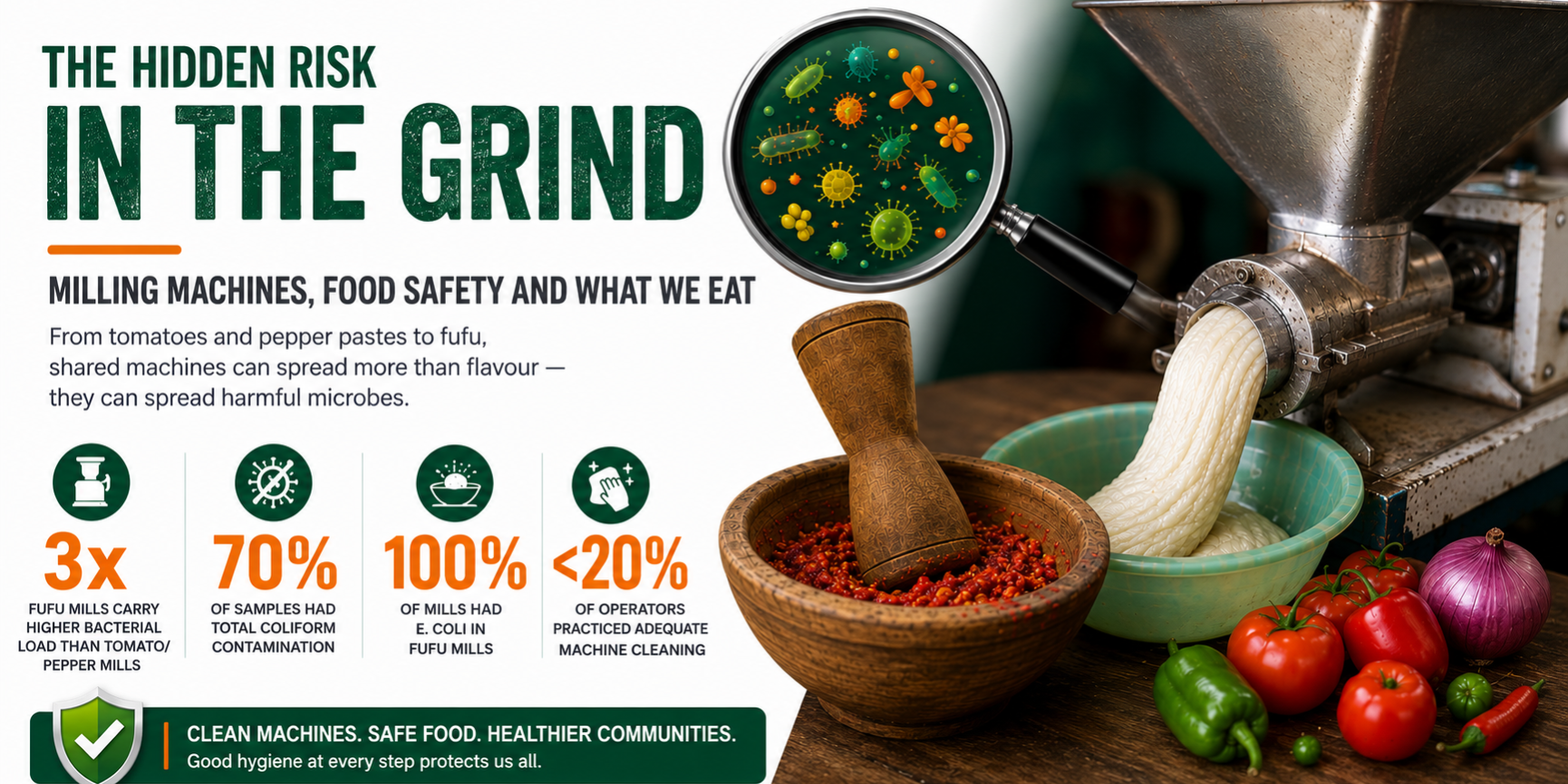
Why Ghana’s Milling Machines Deserve a Food Safety Conversation
A FANIS (Food and Nutrition Intelligence System) briefing on tomato/pepper and fufu milling machines
Introduction
Walk through almost any market in Ghana and you will find them: the tomato and pepper grinding stalls that feed local “chop bars” and restaurants, and the fufu machines that have replaced the mortar and pestle in homes and commercial centres alike. These machines have transformed food preparation by cutting hours of manual pounding and grinding down to minutes (Aboagye et al., 2023). But convenience has come with a quieter cost: milling turns solid, inspectable food into a blended, homogenous mass, and in doing so, it can hide as much as it reveals about what is actually in the meal.
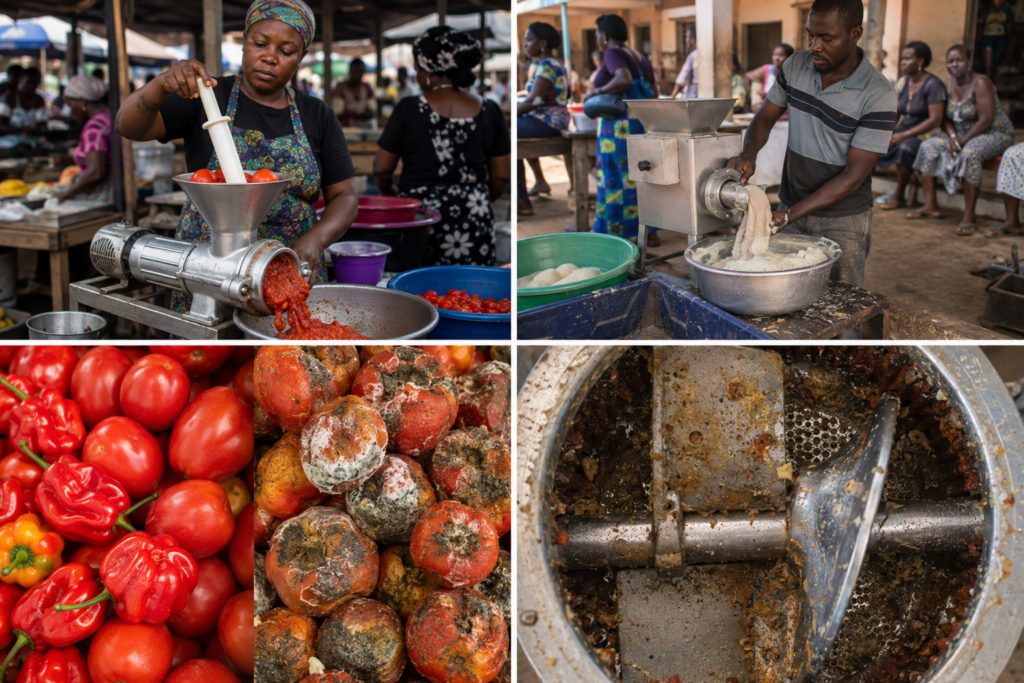
This piece looks at two related but distinct food safety concerns raised by commercial milling in Ghana: first, the practice of grinding partially spoiled tomatoes and pepper into paste before sale to food vendors, and second, the hygienic condition of the milling machines themselves which serve dozens of customers a day and may carry residues, and contamination, from one person’s food into the next.
When Grinding Hides Spoilage
Fresh tomatoes and peppers carry visible cues of quality (bruising, mould, softness, discolouration) that a buyer or cook can inspect before use. Once these vegetables are liquefied into a paste, however, those cues disappear. A blended mix of fresh and partially spoiled produce is, for practical purposes, indistinguishable from a batch made entirely of good produce. This matters because tomatoes are already recognised internationally as a plausible vehicle for foodborne pathogens. Van Dyk et al. (2016), in a farm-to-market study of South African tomato production, found that although no E. coli O157:H7 or Salmonella Typhimurium was recovered from the tomato fruit itself, coliform counts on tomatoes rose substantially between the field and the point of sale, reaching as high as 6.6 log CFU/g at market, and that contaminated irrigation water and poor sanitation of processing surfaces were the principal risk points along the chain. Their findings reinforce a broader point relevant to Ghana’s grinding stalls: contamination risk accumulates through handling and processing, not only through the condition of the raw fruit, and by the time a tomato reaches a grinding machine it may already carry a heavy microbial load regardless of whether it looks spoiled.
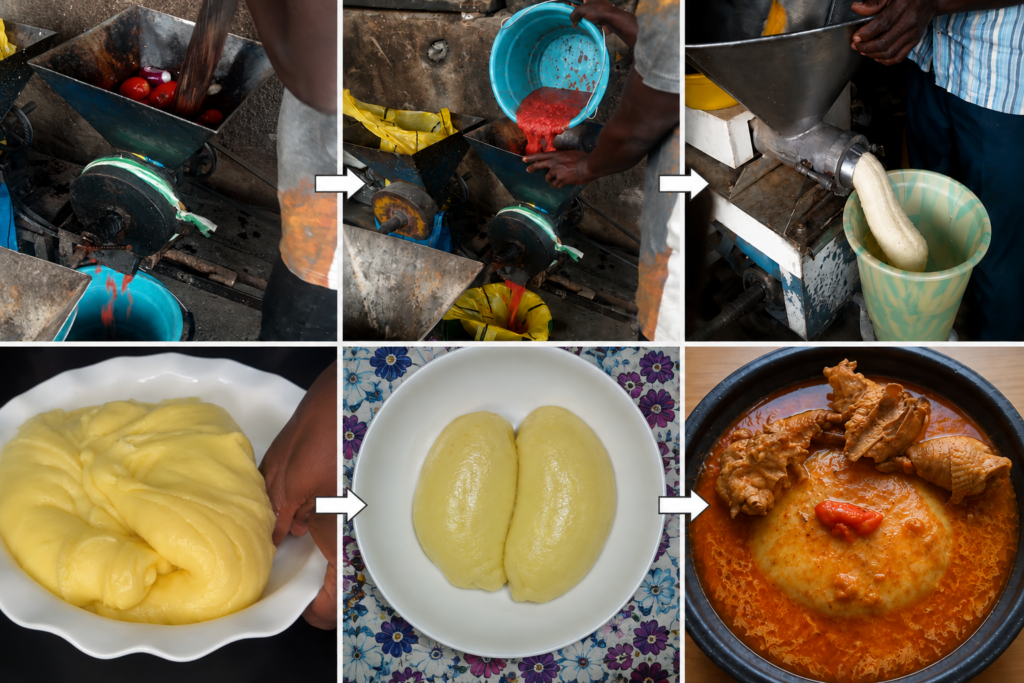
You can never tell the condition by which a meal is prepared
When such produce is blended into paste, the resulting product is sold onward to chop bars and food joints that use it as a base for stews and sauces served to the public. Because the paste is subsequently cooked, some pathogens may be inactivated by heat. However, heat-stable toxins produced by certain spoilage and pathogenic organisms are not necessarily destroyed by cooking, and inconsistent cooking temperatures in informal food settings cannot be assumed to fully offset upstream contamination or spoilage. This is precisely the kind of risk that is difficult to detect through the ordinary senses once grinding has taken place, and it is a gap that formal food safety monitoring in Ghana has not yet addressed.
Milling Machines as Reservoirs of Contamination
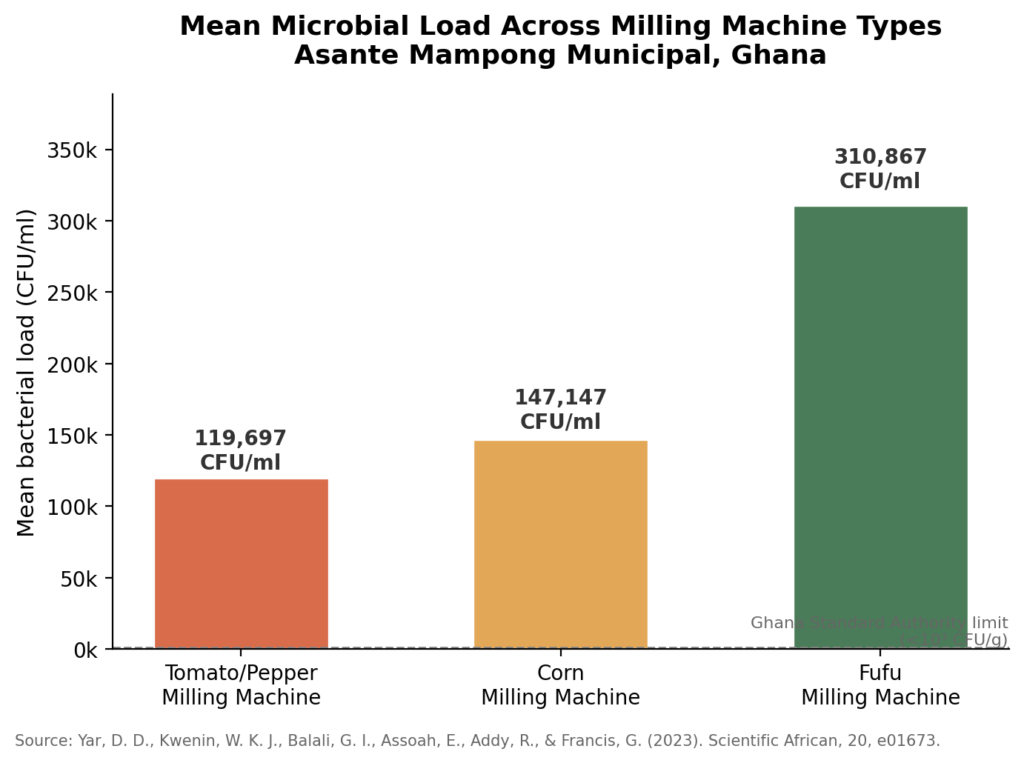
The second concern is the machines themselves. Two recent Ghanaian studies provide direct microbiological evidence that milling equipment is not a neutral pass-through for food, but an active site of contamination.
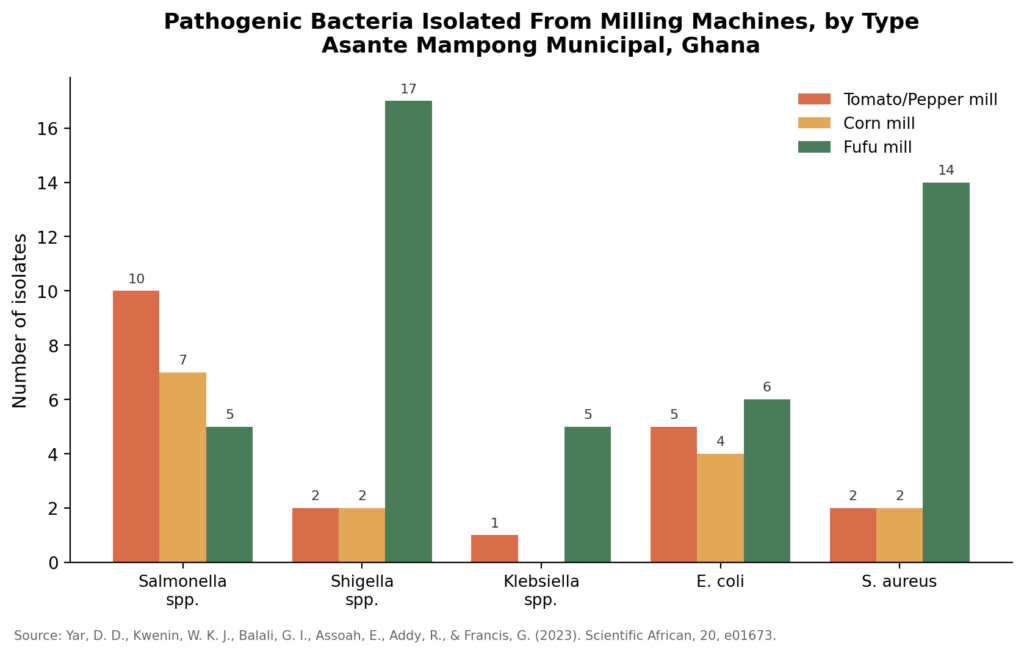
Yar et al. (2023) sampled 55 tomato/pepper, corn, and fufu milling machines across the Asante Mampong Municipality and recorded an overall mean bacterial load of 1.96 × 10⁵ CFU/ml, identifying 82 bacterial isolates across five genera. Salmonella spp. and Shigella spp. were the most prevalent organisms recovered, and the fufu pounding machines carried the heaviest total bacterial load of the three machine types, while pepper/tomato machines yielded the highest proportion of Salmonella isolates. The same study found that only 12.7% of the 55 machine operators surveyed held an operating licence, just under a third were aware that their machines could harbour microbial contamination, and the overwhelming majority (85.5%) serviced their machines only when they broke down rather than on any preventive schedule (Yar et al., 2023).
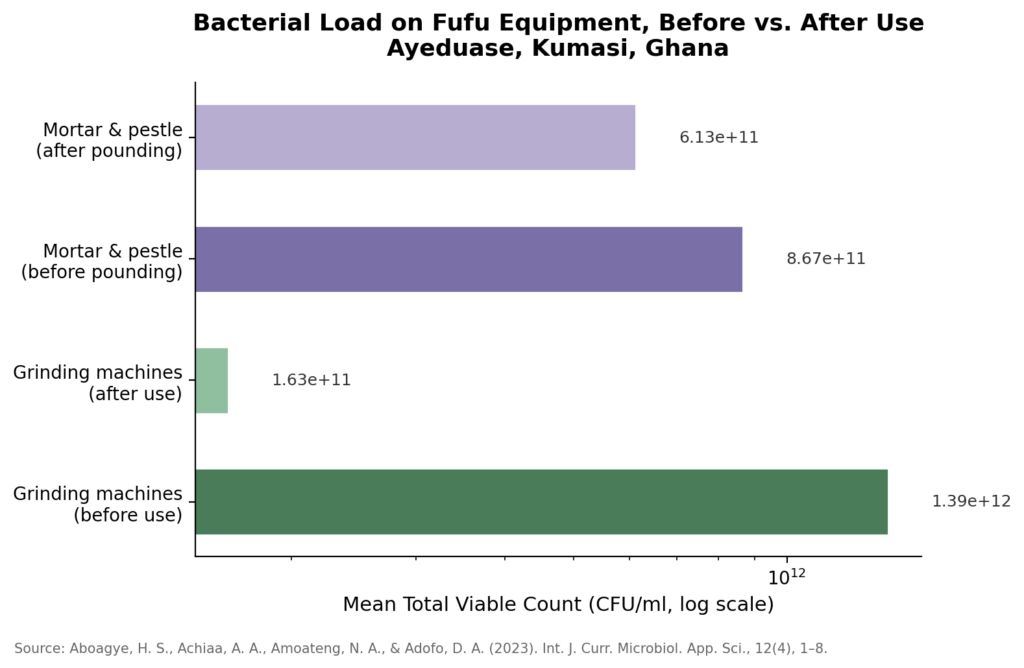
A separate study by Aboagye et al. (2023), working in Ayeduase, a suburb of Kumasi, compared commercial fufu grinding machines with traditional mortars and pestles. Bacterial counts from the grinding machines ranged from 7.5 × 10¹¹ to 2.73 × 10¹² CFU/ml, while mortar-and-pestle samples ranged from 2.5 × 10¹¹ to 1.96 × 10¹² CFU/ml; although grinding machines trended higher, the difference was not statistically significant. All 29 pure bacterial isolates obtained were Gram-positive, dominated by Staphylococcus species (65.5%), alongside Diplococcus, Streptococcus, and Bacillus species, and six fungal genera were also recovered, including Aspergillus, Fusarium, and Penicillium — genera capable of producing mycotoxins under favourable conditions. Notably, bacterial counts taken before the day’s work began were, in several cases, as high as those taken after milling had ended, which the authors interpret as evidence that routine rinsing with water is not adequate to clear residues lodged in the grooves, hoppers, and discharge outlets of the machines (Aboagye et al., 2023).
Taken together, these findings speak directly to the cross-contamination concern: because the same hopper, auger, and discharge chute handle successive customers’ food without being fully cleaned between uses, there is a documented microbiological pathway by which residues and potentially pathogens from one person’s cassava, plantain, or cocoyam can transfer into the next customer’s batch. A person may collect fufu that nominally consists of their own ingredients, but the equipment history shows it is unlikely to be entirely free of what came before it.
Why the Risk Persists: Perceptions and Incentives
Understanding why these risks are tolerated requires looking beyond the machines to the people operating and patronising them. Haleegoah et al. (2015), in a qualitative study of street-vended local foods (Hausa koko, waakye, and Ga kenkey) across Accra, Kumasi, and Tamale, found that vendors and consumers alike tend to define food safety in terms of hygienic appearance, whether food is served hot, and whether it produces any immediate ill effect — rather than in terms of underlying microbiological quality, which is invisible to the naked eye. Consumers in that study explicitly raised concerns about milling machines used to prepare fresh vegetable accompaniments for kenkey, worrying that the machines might be rusty or unclean, yet most continued to patronise these foods because they had not personally experienced illness after eating them (Haleegoah et al., 2015). This is a critical insight: absence of visible harm is being used, understandably but incorrectly, as evidence of safety. Trust (in the vendor’s cleanliness, in regulatory certification, in long personal history of eating a food without apparent consequence) substitutes for actual verification of hygienic practice.
This dynamic compounds the milling-machine problem. Because operators are rarely licensed or trained, cleaning schedules are reactive rather than preventive, and the products of milling (paste, fufu) obscure the visual cues that would normally prompt caution, there is little at any point in the chain that would alert a vendor or consumer to a problem before it has already been consumed.
Implications for Food and Nutrition Policy
These findings point to several concrete gaps that food safety intelligence and policy work in Ghana could usefully address:
- Loss of inspectability through processing. Blending and grinding remove the visual and textural cues that consumers and vendors normally rely on to judge freshness, meaning that spoiled or heavily contaminated produce can be concealed within an otherwise normal-looking paste.
- Equipment as a contamination vector, not just a tool. Milling machines have been shown to carry substantial bacterial and fungal loads, including potentially pathogenic genera, and current cleaning practices among operators are largely inadequate to clear these loads between uses (Aboagye et al., 2023; Yar et al., 2023).
- Cross-contamination between customers. Because machines process sequential customers’ food without thorough interim cleaning, there is a demonstrated pathway for one person’s ingredients to contaminate another’s.
- Weak licensing and oversight. Low rates of operator licensing and limited awareness of contamination risk (Yar et al., 2023) suggest that voluntary compliance alone is unlikely to resolve the problem.
- A perception gap. Vendors and consumers judge safety by appearance, heat, and personal experience rather than by evidence of microbial quality, meaning that public education alone, without accompanying enforcement and infrastructure support, is unlikely to change practice on its own (Haleegoah et al., 2015).
Addressing these gaps would require coordinated action: mandatory licensing and training for milling machine operators; enforced, scheduled cleaning and disinfection protocols (rather than repair-triggered maintenance); routine microbiological surveillance of both raw produce entering markets and the machines that process it; and public communication that shifts the definition of “safe food” away from appearance and toward verified hygienic practice.
Conclusion
The milling machine has quietly become one of the most consequential points in Ghana’s informal food system. It sits between farm and plate, and between one customer and the next, with the power to either dilute or transmit contamination that would otherwise be visible and avoidable. The evidence assembled here suggests that this is not a hypothetical risk: measurable pathogen loads have been recovered from commercial milling equipment in multiple Ghanaian studies, and the informal food safety practices currently in place are not designed to catch what grinding conceals. For FANIS, this represents a clear opportunity to generate the kind of applied food safety intelligence (surveillance data, risk mapping, and evidence-based advocacy) that could inform practical interventions for one of the most widely used, and most overlooked, pieces of food infrastructure in the country.
References
Aboagye, H. S., Achiaa, A. A., Amoateng, N. A., & Adofo, D. A. (2023). Microbiomes of selected commercial fufu grinding machines, mortars and pestles used at homes in Ayeduase, a suburb of Kumasi. International Journal of Current Microbiology and Applied Sciences, 12(4), 1–8. https://doi.org/10.20546/ijcmas.2023.1204.001
Haleegoah, J., Ruivenkamp, G., Essegbey, G., Frempong, G., & Jongerden, J. (2015). Street-vended local food systems actors perceptions on safety in urban Ghana: The case of Hausa Koko, Waakye and Ga Kenkey. Advances in Applied Sociology, 5(4), 134–145. https://doi.org/10.4236/aasoci.2015.54013
Van Dyk, B. N., de Bruin, W., du Plessis, E. M., & Korsten, L. (2016). Microbiological food safety status of commercially produced tomatoes from production to marketing. Journal of Food Protection, 79(3), 392–406. https://doi.org/10.4315/0362-028X.JFP-15-300
Yar, D. D., Kwenin, W. K. J., Balali, G. I., Assoah, E., Addy, R., & Francis, G. (2023). Food milling machines are hosts to pathogenic bacteria: A cross-sectional study in the Asante Mampong Municipal, Ghana. Scientific African, 20, e01673. https://doi.org/10.1016/j.sciaf.2023.e01673