Document Overview
This document, published in the African Journal of Food, Agriculture, Nutrition and Development in March 2022, provides a systematic rapid scoping review of Ghana’s nutrition and health policy landscape between 2010 and 2020. The review was commissioned as part of the process to develop national food-based dietary guidelines and aims to track the evolution of policies while identifying priorities and gaps.
Methodology and Scope
The authors identified and analyzed more than 70 government documents. These were classified into three main nutrition-relevant sectors:
- Health: Including policies on infant feeding, micronutrients, and disease control.
- Agriculture and Food: Focusing on food security and commodity productivity.
- Human Development: Covering social protection, education, and water/sanitation (WASH).
Key Sectoral Findings
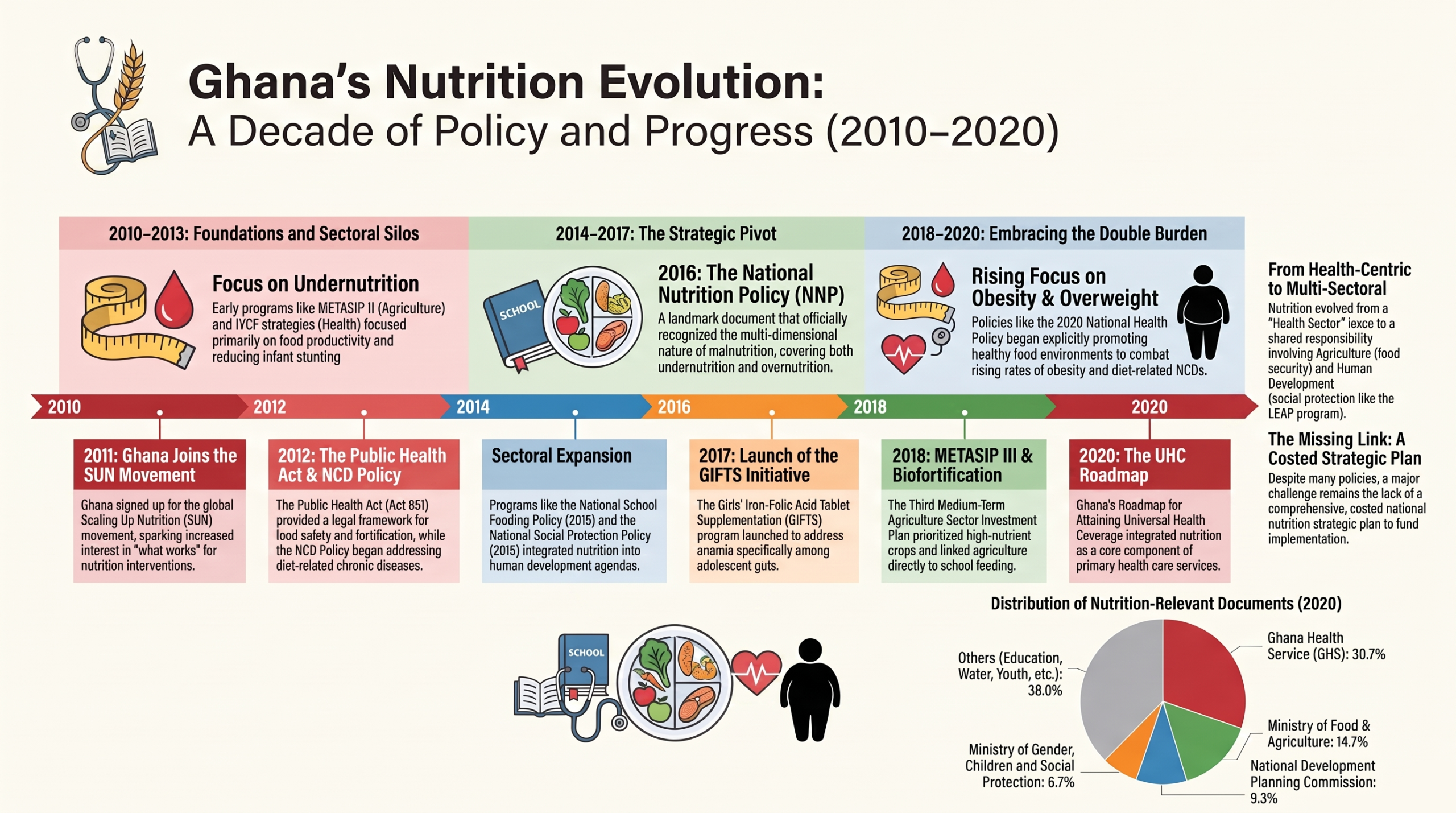
- Health Sector: This sector contains the most nutrition-specific policies (29 documents), focusing heavily on infant and young child feeding (IYCF) and micronutrient deficiencies. A notable recent initiative is the Girls Iron Folate Supplementation (GIFTS) program.
- Agriculture Sector: While agriculture policies like FASDEP II and investment plans (METASIP I-III) aim for food security, the review finds they are primarily driven by productivity and income growth rather than being intentionally nutrition-sensitive.
- Human Development: Social protection programs like LEAP (Livelihood Empowerment Against Poverty) are identified as being more nutrition-sensitive because they provide cash grants that beneficiaries often use for food and healthcare. Educational initiatives, such as the School Feeding Program, also have clear nutrition-related objectives but face implementation hurdles.
Ghana's Nutrition Policy Evolution
Critical Policy Gaps
The review highlights several significant challenges in Ghana's current policy environment:
- Lack of Strategic Planning: A major hurdle is the absence of a costed national nutrition strategic plan to accompany the National Nutrition Policy, meaning there is no official estimate of the resources needed for routine implementation.
- Neglected Nutrition Issues: While stunting and anemia are prioritized, emerging issues such as overweight, obesity, and diet-related chronic diseases are not adequately addressed in current government-funded initiatives.
- Health-Centric Focus: Most nutrition-specific actions are driven by the health sector, with limited integration or nutrition-sensitivity in other departments.
Implementation and Funding Challenges
The document notes that implementation at the subnational level often lags behind national design due to inadequate supplies (e.g., therapeutic foods, job aids, and registers). Furthermore, nutrition programming in Ghana remains heavily reliant on external donor funding, which limits the sustainability and scale-up of key interventions.
Conclusion
The authors conclude that while a broad range of policies exists, they are not yet comprehensive enough to address the "double burden" of malnutrition. They recommend redesigning existing policies to be more nutrition-sensitive and enhancing cross-sectoral coordination to improve efficiency and outcomes.