
Project Title: NutriShed: Adapting Foodshed Analysis for Nutrition Security Planning
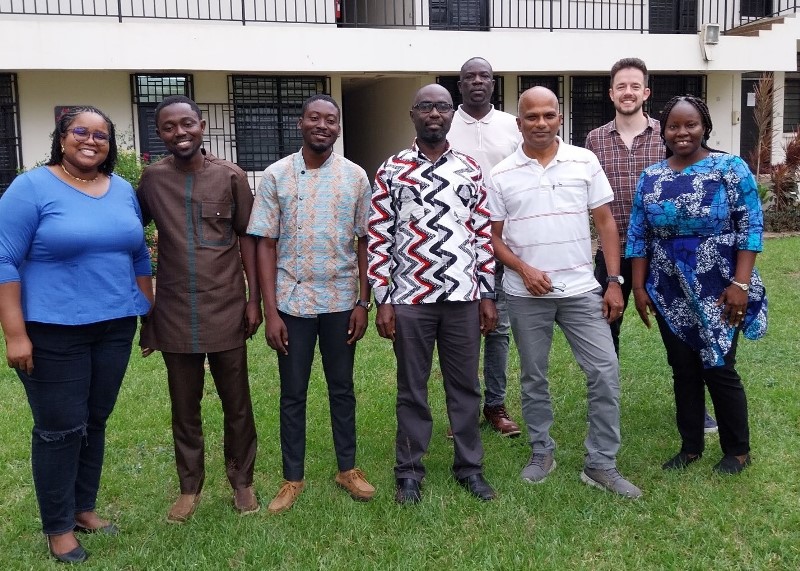
The NutriShed Team
Principal Investigator: Prof. Richmond Aryeetey, University of Ghana School of Public Health
Project Duration: 24 months (Starting April 2023)
Funding: £249,923
Countries of Research: Ghana
Project Collaborators:
- University of Ghana: Prof. Richmond Aryeetey, Dr. Seth Afagbedzi, Dr. Fidelia Dake
- University of Sheffield: Dr. Robert Akparibo, Dr. Bhavani Shankar, Dr. Gregory Cooper
- Food and Agriculture Organization of the United Nations (FAO)
Project Overview
The NutriShed Project seeks to address nutrition security gaps in Ghana by adapting foodshed analysis – a method traditionally used for studying food supply chains—to support nutrition security planning. The project acknowledges the critical role of food environments, transportation networks, and market systems in ensuring stable access to key nutrients for urban and rural populations.
Food insecurity and malnutrition persist in low- and middle-income countries (LMICs) like Ghana, with the FAO estimating that healthy diets are affordable to only 15% of people in Sub-Saharan Africa. With the global goal of eradicating hunger and malnutrition by 2030, policymakers must ensure that regional food systems are capable of supplying adequate, affordable nutrition to urban and underserved populations.
However, in many LMICs, communities lack information on:
- Where their food is produced
- How food is transported and distributed
- What vulnerabilities exist in their nutrient supplies
- How to push in resilience into food systems
The NutriShed Project is pioneering a spatially explicit foodshed-level planning approach that will empower researchers, policymakers, and stakeholders to identify and implement strategies to enhance nutrition security. The project goes beyond traditional food value chain and food environment studies by taking a holistic approach that examines nutrient flow, market facilities, road networks, and food storage infrastructure.
Objectives
- Develop a NutriShed Framework: Create a comprehensive, spatially-informed nutrition security planning framework that goes beyond single food value chains to examine regional food environments holistically.
- Understand Key Nutrient Supplies: Identify and map the range of locally available foods contributing to essential nutrient intake in Ghana.
- Assess Market and Infrastructure Impact: Study how market structures, transportation systems, and storage facilities affect food availability and nutrient accessibility.
- Strengthen Policy and Decision-Making: Provide data-driven recommendations for local and national policymakers to enhance food security and nutrition resilience in Ghana.
Project Locations
The NutriShed Project focuses on two contrasting food systems in Ghana:
- Takoradi (Urban Context)
- A major city with nearly one million people
- A key economic hub with diverse food supply chains and market-driven food distribution
- High reliance on external food sources, making it vulnerable to disruptions in the supply chain
- Asesewa (Rural Context)
- A small town of approximately 20,000 people
- More locally-dependent food system, with many residents engaged in farming and small-scale food trade
- Challenges in transportation, market accessibility, and infrastructure
By studying these two different locations, NutriShed aims to develop insights applicable to both urban and rural food systems, providing adaptable solutions for diverse community needs in Ghana and beyond.
Key Relevance to Nutrition and Public Health
The NutriShed Project is crucial for strengthening food systems and improving nutrition security in Ghana. Its key contributions include:
- Identifying food supply vulnerabilities: The project will reveal where nutrition gaps exist in regional food systems and how to address them.
- Promoting food affordability and accessibility: By mapping nutrient flows and assessing market structures, NutriShed will help create strategies to improve access to affordable, nutritious foods.
- Building food system resilience: The study will highlight ways to reduce food supply disruptions, ensuring stable nutrient availability for Ghanaian communities.
- Empowering policymakers: With data-driven decision-making tools, local and national authorities can design interventions to improve food security and public health nutrition.
Project Partners
The NutriShed Project is a collaboration between leading academic institutions and international organizations, including:
- University of Ghana (School of Public Health) – Leading research efforts in food security and public health nutrition.
- University of Sheffield – Providing expertise in food systems, nutrition policy, and spatial analysis.
- Food and Agriculture Organization (FAO) – Offering global food security insights and technical support.
These partners will work together to develop and implement the NutriShed framework, ensuring that findings are used to improve nutrition security planning in Ghana and other LMICs.
Context and Urgency
- Ghana faces significant nutrition security challenges, including:
Food affordability constraints – Only 15% of people in Sub-Saharan Africa can afford a healthy diet (FAO). - Lack of data on food flows – There is little understanding of where food is produced, how it moves, and where vulnerabilities exist.
- Weak market infrastructure – Poor storage, limited transportation, and inefficient markets create barriers to nutrient accessibility.
With the global push to end hunger and malnutrition by 2030, the NutriShed Project is timely and essential, helping Ghana move toward equitable and sustainable nutrition security.
Potential Impact
- Better Nutrition Planning – A clear understanding of regional food systems will help ensure stable nutrient supplies for communities.
- Stronger Food System Resilience – Policymakers can design interventions to reduce food supply shocks and increase food system efficiency.
- Data-Driven Decision-Making – The project will empower stakeholders with scientific evidence to guide nutrition policies.
- Scalability Beyond Ghana – The NutriShed framework can be replicated in other countries, improving food security globally.