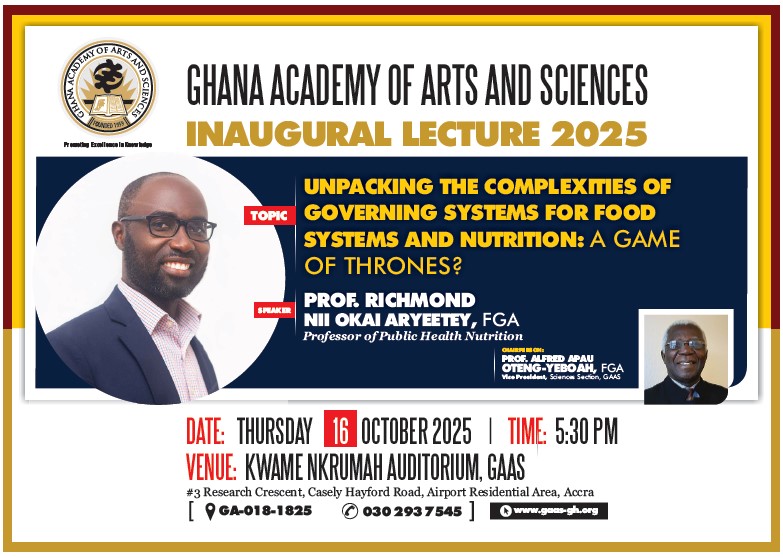
Unpacking food systems, governance, and nutrition

Professor Richmond Aryeetey’s GAAS inaugural lecture reframes food and nutrition as issues of governance, not just agriculture or health. He argues that Ghana’s ability to feed its people depends on leadership, coordination, and political will.

This FANIS editorial series unpacks how affordability, inequality, weak accountability, and poor policy alignment shape the nation’s nutrition outcomes. It explores the real costs of healthy diets, the politics of food, and the reforms needed to build a fairer, stronger food system.


The Series

Click any article card to read the full piece. Each article synthesizes lecture insights and offers practical policy entry points for action.

Can Ghanaians Afford to Eat Healthy?

Economics & Cost of Nutrition

The average cost of a healthy diet has risen from ₵11 (2023) to ₵18 (2025), and up to ₵24 in southern Ghana — pushing nutritious diets out of reach for millions and shifting consumption to cheaper ultra‑processed foods.

Read article →

Governance or Game of Thrones? Who Leads Ghana’s Food System?

Governance & Policy Leadership

Fragmented leadership across 11 ministries and 75+ policies has created a patchwork response. Prof. Aryeetey calls for a National Nutrition Commission under the Presidency to unify action and accountability.

Read article →

₵76 Billion Down the Drain: Ghana’s Food Waste Crisis

Food Systems & Security

Ghana wastes an estimated 3.2 million tons of food annually — worth about ₵76 billion. Losses occur at harvest, storage, transport and household levels; reducing waste can improve availability and affordability.

Read article →

Ghana’s Hidden Hunger: 2.4 Million Children in Food Poverty

Malnutrition, Diets & Health

More than 70% of Ghanaian children — around 2.4 million — live in food poverty. Chronic undernutrition affects 17% of under‑fives and malnutrition costs Ghana roughly $3 billion a year.

Read article →

The Politics of Nutrition: Power, Policy, and the Game of Thrones

Politics & Advocacy

Political commitment must translate into institutions, financing, and implementation. Prof. Aryeetey outlines levels of political will and how to make commitments meaningful.

Read article →

Fixing the System: Coordination, Capacity, and Accountability

Systems Reform

A roadmap for strengthening governance: better coordination (horizontal & vertical), sustainable financing, research and data systems, and capacity building across sectors and districts.

Read article →